Chapter 2 Data and tools
In the previous chapter, we discussed research on the semantic annotation of legal resources, along with crucial factors to consider in this endeavor. Building on that theoretical foundation, we will now delve into the core components of this project: the data available to us and a preliminary analysis of its structure. In particular, we choose to provide a demonstration of the data transformation pipeline by annotating the Italian copyright legislation (Gazzetta Ufficiale 1941) with the copyright ontology (García and Gil 2006).
The decision to annotate Italian copyright legislation was influenced by the significant harmonization already present within EU legislation. This uniformity offers an interesting case study that could be expanded across different Member States. While our focus is on this particular legislation, the transformation pipeline has a versatile nature, making it adaptable to diverse domains.
2.1 The Italian Copyright legislation
Copyright is a legal instrument designed to safeguard "any literary, dramatic, musical or artistic original work, provided that is recorded, either in writing or otherwise" from imitation (Spence 2007). Unlike patents, which cover broader concepts, copyright specifically defends against direct copying and doesn’t account for independent creation. It provides authors with exclusive rights concerning the reproduction, performance, adaptation, and translation of their work. The criteria for determining if an intangible item qualifies for copyright are broad. A "work" encompasses any set of materials organized intentionally. The term ‘literary’ doesn’t assess the content’s quality: originality doesn’t depend on innovation but merely requires some form of intellectual endeavor (Spence 2007). Moreover, copyright law also recognize a spectrum of related rights, extending to creative outputs not directly tied to the original author. This encompasses rights of artists, audio recording producers, broadcasting entities, and, within the European framework, rights of movie producers, database designers, semiconductor creators, and industrial design professionals. Given these overarching criteria, the realm of copyright protection is vast. It spans sectors like visual arts, publishing, performing arts, and areas like source code and databases.
2.1.1 Historical overview
Italy’s copyright law is rooted in Law no. 633 of 22 April 1941 (Gazzetta Ufficiale 1941), which is further complemented by select provisions from the Italian Civil Code of 1942. The digital revolution and the subsequent challenges it posed to traditional copyright frameworks necessitated adaptations in legal structures across Europe.
Initially, this law adhered to the minimum protection requirements outlined in the Berne Convention for the Protection of Literary and Artistic Works of 1886 (WIPO 1886). Over the years, the law has undergone several revisions to comply with various directives from the European Union and to align with changes following the establishment of the Italian Republic. For example, the legal protection of software was addressed through the issuance of Legislative Decree No. 518 of December 29, 1992 (Gazzetta Ufficiale 1992), later amended by Legislative Decree No. 205 of March 15, 1996 (Gazzetta Ufficiale 1996), in response to the EU Directive 91/250/EEC of May 14, 1991 (EURLex 1991).
In recent years, Italy, like other European nations, has integrated European Union (EU) directives designed to harmonize and modernize copyright law in the digital context. These directives address the complexities introduced by digital networks, which have transformed communication, education, creativity, and professional development.
2.1.2 Structural Analysis of Italian Copyright Law in Akoma Ntoso
In order to build the Akoma Ntoso parser, we first need to identify the key components of this particular Akoma Ntoso file, as the specification allows for different implementations, according to the needs of the use-case
2.1.2.1 Some words about Akoma Ntoso
The Akoma Ntoso XML framework, often referred to simply as Akoma Ntoso, serves as a platform-independent XML description of legal resources. In Akoma Ntoso, these documents are enriched with detailed structural annotations, enabling machine-readable processing. This enhanced readability facilitates the development of advanced legislative information systems, promoting better efficiency and transparency in parliamentary, legislative, and judicial settings. Moreover, this framework allows for the creation of software tools that can interpret documents not just as basic text, but in relation to their inherent structure and meaning (Palmirani and Vitali 2011).
In 2019, Italy embarked on a journey to transform its entire legislative repository and judicial decisions into Akoma Ntoso format through the Lexdatafication project (Palmirani 2021). Before this, Italy utilized different standards for encoding such data (Carlo Biagioli et al. 2004). However, these standards had their limitations, such as only extending to the article level and having inaccuracies, notably in the preamble and conclusions. They also missed details on consolidated versions and normative references.
Currently, through Italy’s official portal for legal information, Normattiva, one can download legal documents that align with the Akoma Ntoso guidelines.
2.1.2.2 Metadata
The copyright legislation is enriched with a comprehensive metadata structure that aids in discerning the provenance, lifecycle, and interrelations of the legislative document. The identification section bestows a granular level of granularity by offering identifiers rooted in the FRBR standard (Functional Requirements for Bibliographic Records 1998). Each context is meticulously annotated with the Uniform Resource Identifier (URI), date of creation or modification, authorship, and linguistic medium. Augmenting this, preservation metadata according to ELI ontology (European Union 2023), ensures interoperability with other European legislation.
In tandem with identifying attributes, the metadata encapsulates key milestones in the document’s lifecycle, providing a chronological roadmap of significant events. The analysis section delves into the active and passive modifications undergone by the document, spotlighting insertions and their textual specifics. Complementing this, the references XML element elucidates the foundational links to the document’s genesis and affiliated passive citations. Finally, in the proprietary tag, information related to the document format are provided.
2.1.2.3 Body
The body of the copyright legislation contains the actual legislative text. It is subdivided into 49 chapters, serving as broader thematic divisions. Within these chapters, the document elaborates on its provisions through 306 articles. These articles are then detailed out in 915 paragraphs.
The legislation presents itself as a comprehensive document, organized to address the various dimensions of copyright law. It begins with key chapters such as "DISPOSIZIONI SUL DIRITTO DI AUTORE" and "Soggetti del diritto," which lay down definitions and foundational principles of the law. Such an initiation provides clarity on the legislation’s scope, the types of creative works protected, and the individuals or entities entitled to these protections.
As the document progresses, it delves into specialized domains with chapters dedicated to "Programmi per elaboratore," "Banche di dati," and "Diritti audiovisivi sportivi." These chapters were added at a later stage to adapt the legislation to technological advancements and cultural phenomena.
The latter sections of the legislation are indicative of a holistic approach, addressing both the rights and the potential exceptions or limitations. Furthermore, chapters discussing penalties, enforcement mechanisms, and advisory bodies support a comprehensive view of rights and the procedural rules for their enforcement and guidance.
2.2 The copyright ontology
Another key element for our analysis is the choice of annotations. In this research, our emphasis is on linking the rights articulated in the legal text and their corresponding exceptions to an established domain ontology. Future endeavors could shift towards the modeling of procedural rules using alternative ontological standards like LegalRuleML (Palmirani and Governatori 2021).
The Copyright Ontology is a formalization of concepts and relationships of copyright legislation within the domain of content rights management (García and Gil 2006; García, Gil, and Delgado 2007). The copyright ontology was originally released in 2006 and built upon a more comprehensive work on IPRonto, that encompasses the larger field of Intellectual Property Rights (Delgado and Garcia 2003). Its primary objective is to enable automated and computer-supported copyright management throughout the entire content value chain, in strict accordance with copyright law. Unlike conventional rights languages and ontologies that only consider end-users’ content consumption permissions, this ontology comprehensively addresses all aspects of content life-cycle. It is implemented leveraging W3C standards, such as RDF and OWL. This implementation ensures wide accessibility and ease of integration into existing systems and workflows. The ontology is available in Turtle RDF serialization format, facilitating data exchange and interoperability with other ontologies and systems.
To tackle the complexities of the copyright domain, the ontology is subdivided in three smaller sets of concepts and relationships:
Creation Model, which captures the diverse manifestations of copyright creations as they progress through their life-cycle. It encompasses different forms of original content and tracks their transformations over time.
Rights Model, which represents the legal constructs that regulate content actions. It accommodates various legal systems, encompassing both broad global rights frameworks advocated by organizations like WIPO and specific rights delineated in regional legal regimes.
Action Model, which defines a comprehensive set of actions that govern the life-cycle of content. From creation to distribution, each action is meticulously outlined, facilitating content management and utilization.
By combining these three interrelated models, the Copyright Ontology empowers content creators, managers, and consumers to navigate the complexities of copyright law (García, Gil, and Delgado 2007). In the following sections, we will explore these three subdivisions more in detail.
2.2.1 Creation model
As mentioned above, the creation model aims to capture the various forms a creative work takes during its life-cycle. This is not a new issue area. In particular, extensive research was undertaken in the context of bibliographic studies to represent works.
2.2.1.1 FRBR Creation Model
The FRBR (Functional Requirements for Bibliographic Records) model, proposed by the International Federation of Library Associations and Institutions (IFLA) (Functional Requirements for Bibliographic Records 1998), is the most widely recognized model for modeling intellectual creations. Its main components are:
Work: An abstract intellectual or artistic creation, recognized through its various expressions and characterized by its shared content.
Expression: The realization of a Work in forms like alpha-numeric notation, sound, image, and more.
Manifestation: The physical form of an Expression, ranging from books and maps to films and multimedia kits. It represents physical objects with shared content and characteristics.
Item: A single instance or copy of a Manifestation.
2.2.1.2 MPEG-21 Media Value Chain Ontology
The MPEG-21 Media Value Chain Ontology (MVCO) is delineated in ISO/IEC standard MPEG-21 Part 19 and provides a robust framework for media value chains (Victor Rodriguez-Doncel and Delgado 2009; Gauvin et al. 2010). Key MVCO concepts include:
Work: A creation’s essence, independent of its Manifestations.
Adaptation: A Work inspired by another.
Manifestation: A tangible or perceivable expression of a Work, like digital files or performances.
Instance: An example of a recognized Manifestation, like a specific file.
Copy: A reproduction of an IP Entity. Digital Copies are near-identical, while analog Copies can vary.
While MVCO offers a granular approach, it falls short in discerning between object-based and event-based manifestations and instances, blurring distinctions in the creation process.
2.2.1.3 Overcoming limitations
The Copyright Ontology attempts to address the gaps of previous creation models to the specific needs of the domain.
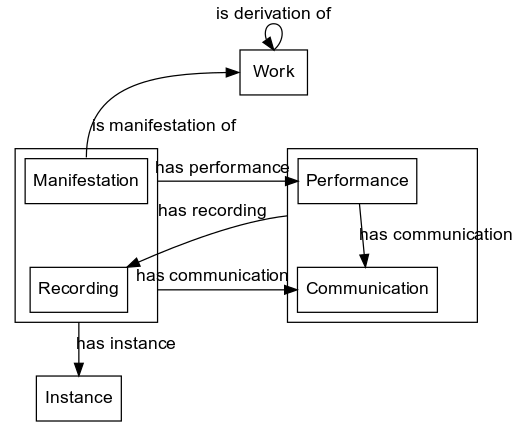
Key elements and their relationships are:
Work: An intellectual or artistic creation with forms ranging from literature, art, and music to software and databases.
Manifestation: The tangible or digital embodiment of a Work, with subtypes like Sound and Audiovisual Recordings.
Instance: A reproduction of a Manifestation or another Instance, either physical or digital.
Performance: The temporal expression of a Work, involving performers or technical means.
Improvisation: A spontaneous, unrehearsed expression of a Work, distinct from a pre-existing Manifestation.
Communication: The distribution of a Work, either as BroadcastEvent (broad) or OnDemandEvent (tailored, such as streaming).
Live Communication: Direct relay of a performance, devoid of non-transient recordings.
These elements delineate a Work’s progression to end-user consumable forms like Instance, Communication, or Performance, emphasizing directly accessible instances for users.
2.2.2 Rights model
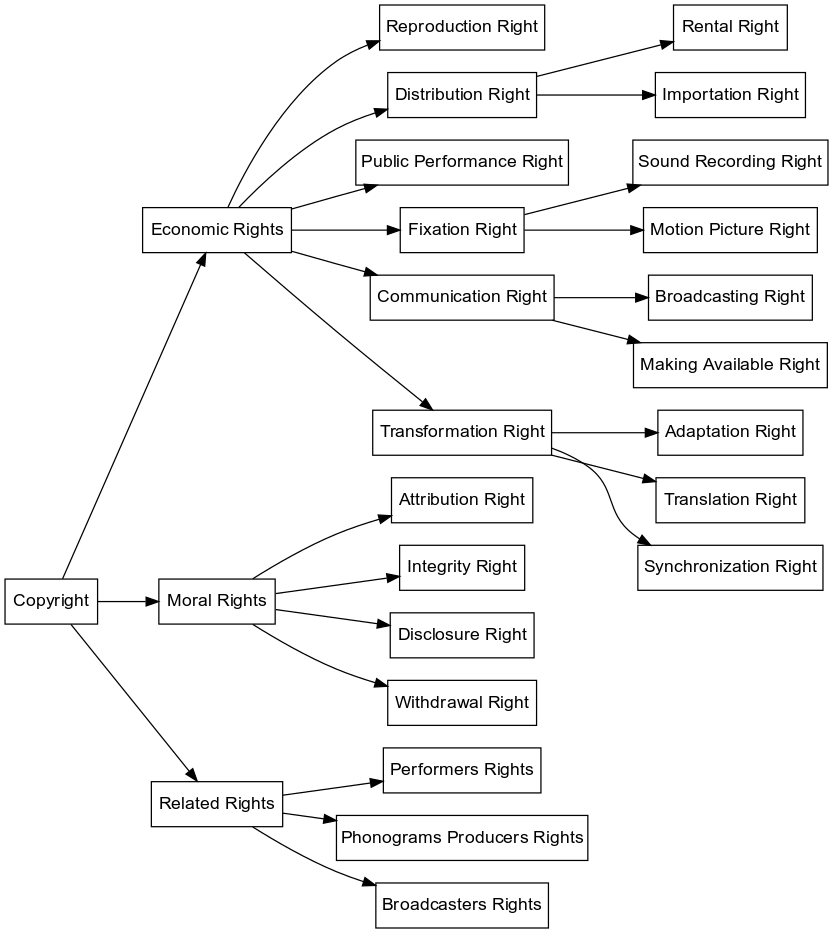
The Rights Model of the Copyright Ontology captures the legal aspects of copyright, encompassing various rights granted to creators and other parties involved in the exploitation of works, as well as exceptions. The Rights Model is designed to be flexible and adaptable to different legal systems worldwide and it takes as reference international treaties deposited at WIPO such as the Berne Convention (WIPO 1886) and the Beijing Treaty (WIPO 2012). It follows recommendations from the World Intellectual Property Organisation (WIPO) and covers both economic and moral rights, as well as copyright-related rights.
The model’s primary focus is on the economic rights as they pertain to the production and commercial aspects of copyright. These economic rights include Reproduction, Distribution, Public Performance, Fixation, Communication, and Transformation. Each of these rights governs a specific action on copyrighted content, such as the right to reproduce or distribute the work.
Moral rights, on the other hand, are distinct from economic rights and are inherently non-commercial. They are always retained by the creator of a work and are primarily concerned with the reputation of the author. These include the Attribution Right, which allows the creator to claim authorship, and the Integrity Right, which enables the creator to object to any modifications that might tarnish their reputation. Notably, while moral rights are integral to many legal systems, they are not universally recognized.
In addition to the aforementioned rights, the copyright ontology also addresses related rights, that are referred to as Neighbouring Rights. These rights are tailored for other key stakeholders involved in the production and dissemination of copyrighted works, such as performers, producers, and broadcasters. Their roles in bringing creations to the audience are significant, and thus they are granted exclusive rights over their contributions. For instance, performers have exclusive rights over their performances, while broadcasters have rights over their broadcasts.
The model also addresses Copyright Exceptions, serving as right limitations. These include Quotation, Education, Reporting, Official Act, Private Copy, Parody, and Temporary Reproduction exceptions, accommodating specific uses and differing per jurisdiction.
2.2.3 Actions model
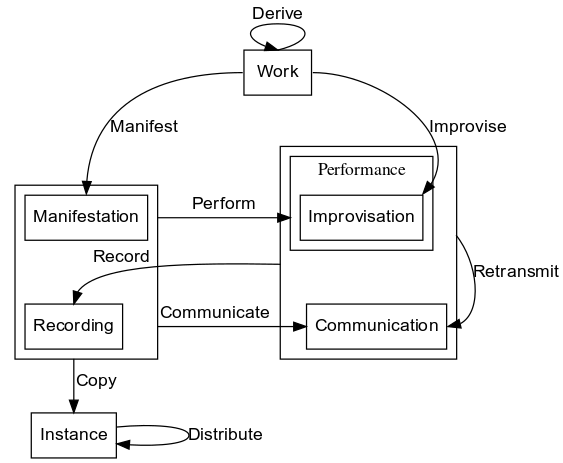
The Action Model in the Copyright Ontology plays a crucial role in capturing the dynamic aspects of creation value chains. By focusing on actions performed by various actors involved in the copyright ecosystem, this "Action-Oriented Modeling" approach creates a cohesive and comprehensive framework.
At the heart of the Action Model are actions that "move" creations along their value chain, allowing for a clear understanding of how a creation progresses from a conceptual Work to a perceivable Manifestation or a dynamic Performance. The Manifest action represents the embodiment of a Work into a tangible object or Manifestation, while the Perform action involves the direct embodiment of a Work into a Performance, without the need for a prior Manifestation.
These actions are not isolated; they are interconnected with the rights identified in the Rights Model, which govern the actions and the creations they involve. For instance, the Copy action, governed by the Reproduction Right, generates replicas of a Manifestation, Recording, or Instance. The Perform action, on the other hand, is not constrained by copyright unless it takes place in public, in which case it falls under the Public Performance Right.
To capture the various nuances and complexities of copyright agreements, the Action Model includes specific actions for managing rights and agreements. The Agree action represents the mutual agreement of parties to abide by constrained actions related to the use or exploitation of copyrighted content. Conversely, the Disagree action revokes an existing agreement by referring to the corresponding Agree action.
For end-users of Works, the Action Model includes actions related to content consumption. The Use action encompasses the consumption of copyrighted content by end-users, with specific kinds of uses like Access, or Copy, allowing users to consume content via on-demand access, live performances, or broadcasts.
2.3 The Doccano Annotation Tool
Another key element of our data transformation pipeline is Doccano (Nakayama et al. 2018), an open-source web application that supports a variety of annotation needs. Its flexibility and user-friendly interface make it a popular choice among researchers and developers in the fields of natural language processing (NLP) and machine learning.
2.3.1 Features
Doccano offers a range of features that cater to different annotation needs:
Labeling Formats: Supports various annotation types including named entity recognition (NER), text classification, and sequence-to-sequence tasks.
Collaboration: Multiple annotators can work on the same dataset simultaneously, facilitating collaborative projects.
Custom Label Creation: Users can define their own labels tailored to specific projects.
Import/Export: Easy import and export of data in formats like JSON and CSV.
User Management: Role-based access ensures data security and project management.
Semi-automated or automated annotation support
2.3.2 Applications in Legal Text Annotation
Doccano’s adaptability makes it a valuable tool for various domains, including legal text annotation. Its ability to handle large volumes of text and support for custom labels allows for efficient annotation of complex legal documents. For instance, labels specific to legal entities, acts, or jurisdictions can be created to extract pertinent information from legal texts.
2.4 Conclusion
This chapter discussed the data and tools that are being used for the project work. Initially, we examined the structure of the Italian copyright legislation, formatted in Akoma Ntoso (Gazzetta Ufficiale 1941). In the second section, we explored the previous work by García and Gil (2006) on the development of the Copyright Ontology. The ‘Creation model’ explained how works qualify for copyright. The ‘Rights model’ detailed the protections given to creators. The ‘Actions model’ showed the different activities and interactions possible within copyright. In the third section, we briefly presented the Doccano annotation tool and its main features (Nakayama et al. 2018).
In the next chapter we will go through the various components of the data transformation pipeline and how they interact with each other.